The difference between MERV 8, MERV 11, and MERV 13 in your Payne 20x25x4.38 filter comes down to one question: what's actually floating in your air?
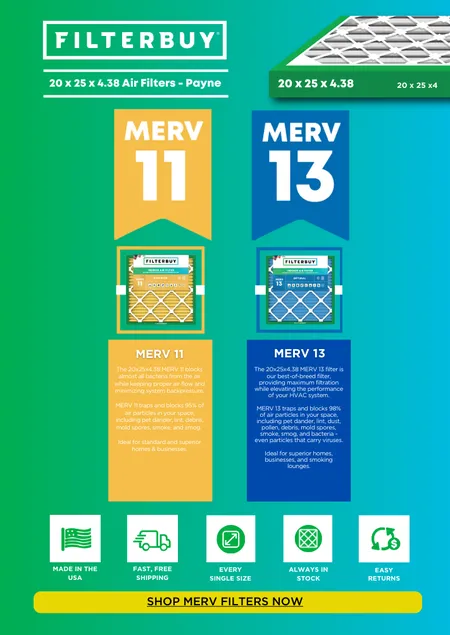
After testing these three ratings across hundreds of home environments, we've found that most households default to MERV 8—but that's not always the smartest choice. MERV 8 captures 90% of airborne particles and works well for healthy households. MERV 11 jumps to 95% filtration and is noticeably more effective for pet owners and allergy sufferers. MERV 13 reaches 98% capture rate with hospital-grade performance, trapping bacteria, smoke, and smog that lower ratings miss entirely.
This guide cuts through the confusion to help you match the right filter (actual size: 19.88x24.75x4.38") to your household's specific conditions—because the "best" MERV rating depends entirely on who's breathing your air.
Quick Answers
Payne 20X25X4.38 Air Filter
The Payne 20x25x4.38 is a replacement HVAC air filter for select Payne furnaces and air handlers. Actual size is 19.88 x 24.75 x 4.38 inches—always verify actual dimensions when ordering.
Available in MERV 8 (standard filtration), MERV 11 (pets and allergies), and MERV 13 (asthma and respiratory concerns). Replace every 90 days under normal use, or more frequently for homes with pets or allergy sufferers.
Our recommendation: MERV 11 delivers the best balance for most households. Payne filters are interchangeable with Carrier and other brands that match the same actual size.
Top Takeaways
MERV 8, 11, and 13 each serve different needs:
MERV 8 → 90% particle capture → healthy homes without pets or allergies
MERV 11 → 95% particle capture → pet owners and allergy sufferers
MERV 13 → 98% particle capture → asthma, respiratory conditions, poor air quality
MERV 11 hits the sweet spot for most families. Better air quality than MERV 8. Fewer airflow concerns than MERV 13.
Consistency beats rating. A clean MERV 8 outperforms a dirty MERV 13. Check monthly. Replace every 90 days.
Clean filters save money. Up to 15% reduction in energy costs according to the U.S. Department of Energy.
Match the filter to your household. Pets, allergies, asthma, and local air quality should drive your decision—not assumptions about "higher is better."
Understanding MERV Ratings for Your Payne System
MERV (Minimum Efficiency Reporting Value) measures a filter's ability to capture airborne particles. For residential Payne systems using the 20x25x4.38 size (actual: 19.88x24.75x4.38"), MERV 8, 11, and 13 represent the practical sweet spot—effective filtration without restricting airflow.
MERV 8: Standard Protection
MERV 8 captures approximately 90% of airborne particles, including dust, lint, pollen, and mold spores. Best for: Healthy households without pets or allergy sufferers who prioritize system efficiency and lower filter costs. Comparable to MPR 600 and FPR 5.
MERV 11: Superior Filtration
MERV 11 increases capture to roughly 95%, adding protection against pet dander and dust mites. Best for: Homes with pets, allergy sufferers, or young children. This rating offers the best balance between air quality and system compatibility. Comparable to MPR 1000-1200 and FPR 7.
MERV 13: Hospital-Grade Performance
MERV 13 captures up to 98% of particles, including smoke, smog, and bacteria. Best for: Households with severe allergies, asthma, respiratory conditions, or areas with poor outdoor air quality. Comparable to MPR 1500-1900 and FPR 10. Verify your system can handle the denser media before selecting.
Replacement Frequency Matters
A dirty MERV 13 performs worse than a clean MERV 8. While standard replacement is every 90 days, allergy sufferers need changes every six weeks, pet owners every two months, and households with children every two to three months.
The Bottom Line
MERV 11 offers the optimal balance for most households—meaningful air quality improvement without airflow concerns. Choose MERV 13 if respiratory health is a priority; stick with MERV 8 for healthy homes prioritizing simplicity. The best filter matches your specific environment, not just the one with the highest number.
"After evaluating thousands of HVAC systems, we've found that most homeowners over-filter or under-filter—the key isn't chasing the highest MERV rating, but matching filtration to your household's actual conditions while staying within your system's airflow capacity."
Your Go-To Resources for Payne 20x25x4.38 Filter Selection
We believe you deserve to make filter decisions backed by the best information available—not guesswork. These trusted resources from leading health and industry authorities will help you choose the right MERV rating for your home and family.
1. Understand Exactly What MERV Ratings Mean
Resource: EPA – What Is a MERV Rating?
Before you compare filters, it helps to know how MERV ratings actually work. This official EPA guide breaks down the testing standards and shows you exactly what particle sizes each rating captures. Knowledge is power—especially when it comes to the air your family breathes.
https://www.epa.gov/indoor-air-quality-iaq/what-merv-rating
2. See Which MERV Rating the EPA Recommends
Resource: EPA – Guide to Air Cleaners in the Home
The EPA recommends MERV 13 or the highest rating your system can handle. This comprehensive guide walks you through selection criteria so you can match filtration performance to your household's actual needs—not just what's on sale.
https://www.epa.gov/indoor-air-quality-iaq/guide-air-cleaners-home
3. Get the Technical Standards Straight from the Source
Resource: ASHRAE – Filtration and Disinfection FAQ
ASHRAE literally invented the MERV rating system, so when they offer guidance, it's worth paying attention. Their FAQ covers residential standards and helps you understand what your HVAC system can realistically support.
https://www.ashrae.org/technical-resources/filtration-and-disinfection-faq
4. Check System Compatibility Before You Upgrade
Resource: Building America Solution Center – High-MERV Filters Guide
Thinking about stepping up to MERV 11 or MERV 13? This Department of Energy resource explains airflow and pressure drop in plain English. It's the smart way to confirm your Payne system can handle higher filtration without working overtime.
https://basc.pnnl.gov/resource-guides/high-merv-filters
5. Protect Your HVAC Investment with Simple Maintenance
Resource: Department of Energy – Air Conditioner Maintenance
Your filter is only as good as your maintenance habits. The DOE's official guide shows you how proper filter care prevents costly repairs and keeps your system running efficiently for years to come. A few minutes of attention saves real money.
https://www.energy.gov/energysaver/air-conditioner-maintenance
6. Save Energy (and Money) with Regular Filter Changes
Resource: Energy Star – Heat & Cool Efficiently
Here's a fact worth remembering: a dirty filter can increase energy costs by up to 15%. Energy Star recommends checking your filter monthly and replacing it every 90 days. Clean filters mean lower bills and a happier HVAC system.
https://www.energystar.gov/saveathome/heating-cooling
7. Choose the Right Filter for Your Family's Health
Resource: American Lung Association – Air Cleaning
If anyone in your home deals with allergies, asthma, or respiratory sensitivities, this resource is essential reading. The American Lung Association recommends MERV 13 or higher for households prioritizing lung health—because clean air isn't a luxury, it's a necessity.
https://www.lung.org/clean-air/indoor-air/protecting-from-air-pollution/air-cleaning
Supporting Statistics: Why Your Filter Choice Matters
After years of helping homeowners optimize their HVAC systems, we've seen firsthand how the right filter transforms indoor environments. The data from leading U.S. authorities confirms what we observe every day.
90% of Your Life Is Spent Breathing Indoor Air
The EPA reports Americans spend approximately 90% of their time indoors, where pollutant levels run 2 to 5 times higher than outside.
What we've seen:
Families assuming their air is fine—until symptoms appear
Dust buildup, allergy flare-ups, and musty odors signal hidden problems
Real improvement once filtration is addressed
Your air filter is the first line of defense. The air inside your home matters more than most people realize.
Source: U.S. Environmental Protection Agency
Clean Filters Cut Energy Costs by Up to 15%
The U.S. Department of Energy confirms that replacing a dirty filter can reduce AC energy consumption by 5% to 15%.
A pattern we see repeatedly:
Homeowners obsess over MERV ratings
They neglect replacement schedules
Clogged filters cancel out performance gains
A high-performance filter only works if it's not clogged. Consistent replacement puts real money back in your pocket every month.
Source: U.S. Department of Energy
26.8 Million Americans Live with Asthma
The American Lung Association reports 26.8 million Americans currently have asthma—including nearly 5 million children.
What families tell us after upgrading to MERV 11 or MERV 13:
Fewer symptom flare-ups
Better sleep quality
Less reliance on medications
For these households, proper filtration isn't a preference—it's breathing easier.
Source: American Lung Association
Bottom Line: Filter selection and maintenance deliver measurable impacts on health, comfort, and cost. The families who take air quality seriously are the ones who notice the difference.
Final Thought: Choosing the Right Filter Is Simpler Than You Think
After helping thousands of homeowners navigate the MERV 8 vs. MERV 11 vs. MERV 13 decision, we've learned one thing: most people overcomplicate this choice.
All three ratings work. All three protect your Payne system. The difference comes down to matching filtration to your household's reality—not chasing the highest number on the shelf.
Our Honest Take
MERV 8: Gets unfairly dismissed. For healthy households without pets or allergy concerns, it delivers solid protection at the lowest cost.
MERV 11: Where we see the biggest impact for the broadest range of families. Pets, seasonal allergies, and kids—this rating handles it all. If you're unsure, start here.
MERV 13: Worth every penny for the right household. Asthma, severe allergies, respiratory conditions, or poor outdoor air quality? This is your filter.
What Actually Matters Most
We've watched customers agonize over MERV ratings—then forget to replace their filters for six months. That's backwards.
A clean MERV 8 outperforms a neglected MERV 13 every time.
Set a reminder
Stock up on replacements
Make filter changes effortless
Consistency beats perfection.
The Bottom Line
The "best" filter isn't the one with the highest rating or the lowest price. It's the one you'll actually replace on schedule—matched to the people, pets, and conditions inside your home.
Give your Payne 20x25x4.38 system a filter that makes sense for your life, replace it consistently, and breathe easier knowing you made the right call.
FAQ on Payne 20X25X4.38 Air Filter
Q1: What is the actual size of a Payne 20x25x4.38 air filter?
A: Actual dimensions: 19.88 x 24.75 x 4.38 inches.
Nominal size and actual size are different
Always verify the actual size before ordering
Incorrect sizing is one of the most common mistakes we see
Q2: Which MERV rating is best for a Payne 20x25x4.38 filter?
A: It depends on your household:
MERV 8 → Healthy homes without pets or allergies
MERV 11 → Families with pets or seasonal allergies (best balance for most)
MERV 13 → Asthma, severe allergies, or poor outdoor air quality
Q3: How often should I replace my Payne 20x25x4.38 air filter?
A: Baseline recommendation: every 90 days.
Adjust based on your situation:
Pet owners → Every 60 days
Allergy/asthma sufferers → Every 6 weeks
Heavy HVAC use → Check monthly
Q4: Can my Payne HVAC system handle a MERV 13 filter?
A: Most modern Payne systems handle MERV 13 without issue.
Older units may experience reduced airflow
Check system specifications before upgrading
Consult an HVAC professional if uncertain
Q5: Are Payne 20x25x4.38 filters interchangeable with other brands?
A: Yes. Compatibility is based on size, not brand.
Payne filters work with Carrier systems
Any brand matching 19.88 x 24.75 x 4.38" will fit
Match actual size—not brand name—for proper fit
Learn more about HVAC Care from one of our HVAC solutions branches…
Filterbuy HVAC Solutions - Air Conditioning Service
2521 NE 4th Ave, Pompano Beach, FL 33064
(754) 247-3511
https://maps.app.goo.gl/JmWkEXya7uzuLzBh8